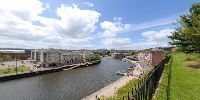

Elevated view over Exeter Quay from Colleton Crescent
Exeter, Devon, England, UK
2.00pm Sunday 22nd June

Loading panorama viewer ...
Configuring ...
© 2008 Peter Stephens, All Rights Reserved.
Caption
Exeter Quay was once an international port thriving through mainly in the export of woollen cloth, but by the 13th century sea craft could no longer reach Exeter by river, so a canal was constructed around 1563. This canal linked the city to the estuary again and the port trade began to prosper once more. Those wanting longer walks can travel along the canal side footpaths down to the locks, maybe stopping off at one of the alehouses for lunch. The Butts Ferry can also be found at the Exeter Quayside. This manually operated ferry links the quayside to the opposite bank. This can be seen in the VR image.
The Customs House dating back to 1681 is one of the earliest brick buildings in Exeter. The cannons that stand outside never reached their destination and still remain unfired.
The Exeter Ship cannal can be seen on the other side of the river.
Colleton Crescent is perhaps the finest group of late Georgian houses in Exeter, and were built by Matthew Nosworthy. The crescent is built above the quay and has a fine view over the river, canal basin and towards Haldon Hill. The foundation stone was laid by Louisa Colleton on 3rd September 1802. Each end of the crescent is a three story house, with the main block consisting of four storey houses, some with decorative iron verandas.
A couple more VR images from the same area
http://www.sphereworks.co.uk/exeter_quay.php
More infomation about Exeter Quay http://www.exeter.gov.uk/index.aspx?articleid=2820
More infomation about Colletion Crescent http://www.exetermemories.co.uk/EM/_streets/colleton.php
More infomation about Exeter Quay http://www.exeter.gov.uk/index.aspx?articleid=2820
More infomation about Colletion Crescent http://www.exetermemories.co.uk/EM/_streets/colleton.php
Equipment
Nikon D200, 10.5mm Fisheye Lens. 360 Presision Aboslute pano head. PTGui, Photoshop, Pano2VR.
 Tap or click the zoom icon in the bottom right corner of the picture to switch between in-page and fullscreen view