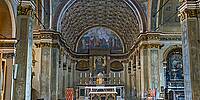

The smart paint (Basilica di Santa Maria in San Satiro)
via Torino - Milan - Italy
September 30th 2026 - 16,40. (UTC + 2)

© 2026 Roberto Mancuso, All Rights Reserved.
Santa Maria presso San Satiro — Bramante’s Faux Choir
In the heart of Milan, just a few steps from the Duomo, the church of Santa Maria presso San Satiro houses one of the Renaissance’s most famous perspective illusions: the faux choir designed by Donato Bramante between 1482 and 1486.
Looking from the central nave, a deep apse seems to open behind the altar, with three bays, columns, arches, and a luminous coffered barrel vault. In reality, that space does not exist: the structure is only 97 centimetres deep and unfolds as a masterful trompe-l’œil made of stucco, terracotta, and painting.
The street behind the church did not allow for the construction of a true apsidal choir; Bramante turned this limitation into an opportunity, applying a forced, converging perspective that visually expands a few decimetres into an image of monumental space, as if the church extended for about ten metres.
The stuccoes are not merely a painted backdrop: the low reliefs, mouldings, coffers, and gold and blue details create real shadows and reflections, reinforcing the sense of depth. The large lunette houses The Miracle of the Blessed Virgin Stabbed by Massenzio, while beneath the altar is the ancient fresco of the Virgin and Child.
In this 360° panoramic view, the illusion reveals its full power: as long as the eye remains at Bramante’s intended viewpoint, the architecture appears authentic. But when you virtually move toward the altar, the perspective is exposed and the “choir” shrinks to an extremely thin wall space—a masterpiece in which geometry, light, and perception become architecture.
Santa Maria presso San Satiro — Il finto coro del Bramante
Nel cuore di Milano, a pochi passi dal Duomo, la chiesa di Santa Maria presso San Satiro custodisce uno degli inganni prospettici più celebri del Rinascimento: il finto coro ideato da Donato Bramante tra il 1482 e il 1486.lombardiabeniculturali+1
Guardando dalla navata centrale, dietro l’altare sembra aprirsi una profonda abside, percorsa da tre campate, pilastri, archi e una luminosa volta a botte cassettonata. In realtà quello spazio non esiste: la struttura è profonda appena 97 centimetri e si sviluppa come un magistrale trompe-l’œil in stucchi, terracotte e pittura. (lombardiabeniculturali)
La via retrostante non permetteva di costruire un vero coro absidale; Bramante trasformò questo limite in un’occasione, applicando una prospettiva forzata e convergente che dilata visivamente pochi decimetri in un’immagine di spazio monumentale, come se la chiesa si prolungasse per circa una decina di metri. (geometriefluide)
Gli stucchi non sono un semplice fondale dipinto: i rilievi bassi, le cornici, i cassettoni e i dettagli dorati e azzurri creano ombre e riflessi reali, rafforzando la sensazione di profondità. La grande lunetta ospita il Miracolo della Beata Vergine pugnalata da Massanzio, mentre sotto l’altare è collocato l’antico affresco della Vergine con il Bambino. (lombardiabeniculturali)
In questa vista panoramica a 360°, l’illusione rivela tutta la sua forza: finché l’occhio resta sul punto di vista previsto da Bramante, l’architettura sembra autentica. Spostandosi virtualmente verso l’altare, però, la prospettiva si svela e il “coro” si riduce a un sottilissimo spazio murario: un capolavoro dove geometria, luce e percezione diventano architettura. (geometriefluide)
Kandao 3 ultra, hand made pole, kandao studio, ptgui, photoshop
music has been composed and played and managed by a dear friend of mine
 Tap or click the zoom icon in the bottom right corner of the picture to switch between in-page and fullscreen view