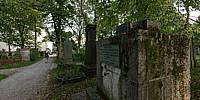

General Bastoul — Died on the 12th of Frimaire in Year 9
Munich, Bavaria, Germany
September 25, 2011, 15:25 UTC (17:25 local time)

Loading panorama viewer ...
Configuring ...
© 2011 Carl von Einem, All Rights Reserved.
Caption
Most people walking by (like the woman wearing a Dirndl) don't notice this but according to the inscription the person who is buried here died on a very strange date: the 12th of Frimaire in year 9.This is one of the rare occurrences outside of France where the French Republican Calendar (aka French Revolutionary Calendar) can be found. This detail concerning the revolution obviously didn't turn out to be a very successful concept: it was in use only for a very short time, mainly between 1793 and 1805. Follow the links below to learn how it worked.
General Louis Bastoul died on January 25th, 1801, after having been wounded during the Battle of Hohenlinden on December 3rd, 1800, where he led a division against Austrian and their allied Bavarian forces. The following victory of the revolutionary French over the Austrian monarchy's troops ended the War of the Second Coalition and also marks the transition from the medieval Holy Roman Empire of the German Nation to a new epoch.
The description in a book about this beautiful graveyard indicates that originally the tomb carried an obelisk on its top which was destroyed during WWII.
The main tablet bears the following inscription in French:
L'ARMÉE DU RHIN
COMMANDÉE PAR LE GÉNÉRAL MOREAU
À LA MÉMOIRE DU GÉNÉRAL BASTOUL
BLESSÉ À LA BATAILLE DE HOHENLINDEN
LE 12. FRIMAIRE.
MORT À MUNICH LE 25. NIVOSE
L'AN 9. DE LA REP. FRANÇOISE.
Here is a translation together with some explanatory links:
The Army of the Rhine
Under command of General Moreau
In commemoration of General Bastoul
Wounded at the Battle of Hohenlinden
On the 12th of Frimaire.
Died in Munich on the 25th of Nivose
in the 9th year of the French Republic.
The upper tablet was installed 200 years later and bears the following inscription in German:
1800
STREIT – NOT – LEID
–––––––––––––––––
FRIEDE – FREIHEIT
2000
An English translation would read as follows:
1800: Fight – Misery – Agony
2000: Peace – Freedom
At the time when this tomb was erected the war graves section was situated in this part of the graveyard. The graveyard itself may be somehow familiar to early visitors of The World Wide Panorama since Markus Matern already featured Fraunhofer's tomb back in 2004.
Location
Lat: 48° 7' 41.7" N
Long: 11° 33' 57.1" E
Elevation: 524 m (1719 ft)
Precision is: High. Pinpoints the exact spot.
Equipment
- Nikon D300 / Nikkor f2.8 14-24mm
- 360Precision Adjuste panoramic head / Manfrotto tripod
- Hugin 2011.2.0 / Pano2VR 3.1 / Photoshop CS5
- some cool history books (and Wikipedia)
 Tap or click the zoom icon in the bottom right corner of the picture to switch between in-page and fullscreen view