

Loading panorama viewer ...
Configuring ...
© 2010 Peeter Sepping, All Rights Reserved.
Caption
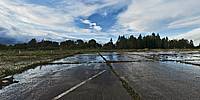
In my childhood and teenage years in the 70s and 80s I often spent my summers in south Estonia near Tartu. Part of these warm and sunny summer days was thunderclap-like noise produced by powerful military aircraft, constantly taking off due their duty from Raadi Military Airport near Tartu.
A large area near Tartu, which earlier had been the location of the picturesque Raadi manor, later the Estonian National Museum, was then the adventive home for the Soviet Strategic Air force.Since 1990, when Soviet military forces were withdrawn from Estonia and the last commander of the airport Dzhokhar Musayevich Dudayev turned over the property to the Estonian sovereign state, the conditions where established to restore and develop the Estonian National Museum location there. The international competition for the design and execution of the 34,000 m² building, housing a collection of 140,000 objects, was launched in 2005. The competition’s winner, young architects from DGT Architects, did not deny, that they were mostly inspired by observing the monumental shape of the former Soviet military base from Google Earth. They believed that their project ”MEMORY FIELD”, where the Estonian National Museum becomes a continuation of the airfield, regenerates this area and gives new meaning to the physically preset ruin of a painful history.
Now the ground preparations for the building works are held and if hopefully everything succeeds, in 2014 a new story starts right here.
Equipment
Canon EOS 5D with Canon 15mm fisheye
 Tap or click the zoom icon in the bottom right corner of the picture to switch between in-page and fullscreen view