
Croaghbeg Court Tomb - Megalithic Heritage
Shalwy Valley, South West Donegal, Ireland
24th June 2012 14:00 GMT

Loading panorama viewer ...
Configuring ...
© 2012 George Row, All Rights Reserved.
Caption
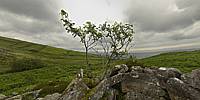
Croaghbeg is a Megalithic stone structure known as a "full-court tomb". It was uncovered and investigated by archaeologists between 1969 and 1973. That excavation revealed a long cairn - about 40m - with a two chambered gallery, and a subsidiary chamber on the North Western end of the court.
The site is also sometimes referred to as Pontabane Cairn . (I think perhaps the hump that existed here before the excavation was called "Pontabane Cairn" and what was revealed by the excavation was named "Croaghbeg Tomb". But that is just a guess on my part.)
Looking down you can see the massive stones that form the sides and back of the chambers. They are each about 2m in diameter. The lintel stones at the entrance and between the chambers are each about 2.5m wide and almost a metre thick.
This is one of three Megalithic tombs in the Shalwy valley, which lies on the road from Killybegs to Slieve League about 6km West of Killybegs and about 3km East of the village of Kilcar.
Based on its style of construction it is likely that Croaghbeg was built about 6,000 years ago - about 1,000 years before work started on Stonehenge or the great Egyptian pyramids.
Muckross Head is just along the coast between Shalwy and the village of Kilcar.
Despite being somewhat neglected, the site is open for access by the public. It is reached from a narrow local road by climbing over a gate and crossing two small steeply sloping fields. (It is the road just West of the marker on the GoogleMap from the link below.)
In winter the fields are bare but soggy underfoot. In summer they are covered in head-high ferns which can be very wet even when the ground is dry. So visitors need clothes and shoes suited to rough, wet terain.
There are a lot of wild orchids and other wildflower treats in the surroundings, which perhaps provide compensation for the site's untended state.
Prints from Croaghbeg Court Tomb are available from a print-on-demand service.
I have also made this and other Photographs of South West Donegal available as:
Donegal Greetings cards ,
Mounted prints of South West Donegal ,
Framed prints of South West Donegal
Canvas prints of South West Donegal
Poster prints of South West Donegal
and even as
iPhone covers of Donegal scenes
I have also made this and other Photographs of South West Donegal available as:
Donegal Greetings cards ,
Mounted prints of South West Donegal ,
Framed prints of South West Donegal
Canvas prints of South West Donegal
Poster prints of South West Donegal
and even as
iPhone covers of Donegal scenes
Location
Lat: 54° 37' 24.39" N
Long: 9° 33' 54.37" W
Elevation: 50m
Precision is: High. Pinpoints the exact spot.
Equipment
Equipment:
The source images were taken with a Canon EOS 5D, Zenitar 16mm fisheye f/2.8 lens. The camera was mounted on a Kaiden Kiwi panorama adapter on a Manfrotto 190XDB tripod.Horizontal photographs were taken at 60° angles and also two ground shots and a sky shot. Each "shot" consisted of three bracketed exposures from +2 to -2 stops.
A total of 27 separate images were combined using Hugin in order to achieve this High Dynamic Range type result.
 Tap or click the zoom icon in the bottom right corner of the picture to switch between in-page and fullscreen view