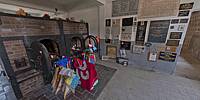

Crematorium at Mauthausen Concentration Camp
Mauthausen, Austria, about 12 miles east of Linz
June 27, 2010, 12:16 pm local

Loading panorama viewer ...
Configuring ...
© 2010 Charles M. (Chuck) Lampman, All Rights Reserved.
Caption
I had given up on an entry for "Forgotten Places," but on the last day of the shooting period, as my 14-year-old granddaughter and I toured the former Nazi concentration camp at Mauthausen, Austria, I realized that this place represented a piece of history lived by my parents generation and well remembered by mine, but forgotten by many of my childrens' generation, and only a dim recollection of a brief mention in a classroom by my grandchildrens' generation. It should not be so.Mauthausen was one of the only two camps in the whole of Europe to be labeled as "Grade III" camps, which meant that they were intended to be the toughest camps for the "Incorrigible Political Enemies of the Reich." Unlike many other concentration camps, intended for all categories of prisoners, Mauthausen was mostly used for extermination through labor of the intelligentsia, who were educated people and members of the higher social classes in countries subjugated by the Nazi regime during World War II.
In addition to a large number of mostly Hungarian, Polish and Dutch Jews, we were surprised to learn that the camp housed German, Austrian and Czechoslovak socialists, communists, anarchists, homosexuals, and people of Roma origin (i.e., Gypsies), as well as Jehovah's Witnesses, Spanish Republicans and Soviet POWs and civilians. These prisoners were worked to death, primarily quarrying stone for use in building projects throughout the Reich.
Equipment
Nikon D300, Rokinon 8mm f3.5 lens, Opteka monopod, iMac G7 w 8gb RAM, Photoshop CS5, PTGui Pro, CubicConverter
 Tap or click the zoom icon in the bottom right corner of the picture to switch between in-page and fullscreen view