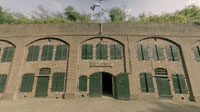

Defence Line of Amsterdam, the oldest building: Fort Abcoude
Abcoude, North Holland, The Netherlands
20 June 2004 17.30 local (Amsterdam), 16.30 GMT

Loading panorama viewer ...
Configuring ...
© 2004 Jan van der Woning, All Rights Reserved.
Caption
Already in the 15th century there was a wall around the city of Amsterdam, of which some remains can still be found. Later another wall was built and many of these old strongholds are still visible on the map as small waves in the Singel canal.In 1815 King Willem I gave an order to General Krayenhoff to formulate a plan for the defence of the whole country. It was decided that a Defence Line would be built around Amsterdam with simple forts located near the dry areas of the inundations.
On the 8th of April 1874 the Vestingwet (Fortress Law) was passed. It was required to handle the modernisation of the existing Dutch defences. The main part of this new line was to become inundation positions. The construction started in the years after 1880. The total length of the whole line is 135 km with 42 fortresses.
Fort near Abcoude
The oldest land based fort of the Defence Line. The bombproof buildings were built between 1884 and 1887 of both old style brick and modern concrete. The masonry is in perfect condition and still looks as if it was finished last year.
It could shelter 284 men and there was room for ammunition.
It is now owned by the city of Abcoude and because it was a military object it could not be visited and has a wide range of animals and plants, some of which are rare.
The site is of outstanding universal value as it is an exceptional example of an extensive integrated defence system of the modern period which has survived intact and well conserved since it was created in the later 19th century. Date of Inscription: 1996
Equipment
Seitz Roundshot 220 VR, 15 mm Nikon, Kodak Portra 160 NC, Flextight scanner, Photoshop, QTVRAS
 Tap or click the zoom icon in the bottom right corner of the picture to switch between in-page and fullscreen view