

Loading panorama viewer ...
Configuring ...
© 2011 Iñaki Rezola, All Rights Reserved.
Caption
Certains anciens philosophes grecs—dont Platon et les pythagoriciens—ont perçu l'ordre, l'harmonie et la beauté du Cosmos comme produite par des entités mathématiques pures—tels que chiffres, figures géométriques, proportions et symétries. Ceux-ci définiraient les limites des êtres qui peuplent l'univers, en donnant chacun son individualité dans l'espace et le temps—autrement indéfinis et illimités. Le dodecahédron—assimilé à une sphère—serait la forme de cet univers.Le même concept a été appliqué à la vie humaine: les mots MEDEN AGAN—rien de trop—sculptés sur le temple d'Apollon à Delphes suggérait aux pèlerins qui s'y rendaient que le secret d'une vie sage, belle et heureuse consistait à la modération et au respect des limites fixées à l'homme par la Nature.
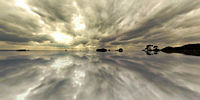
(Le temple ici représenté n'est pas celui de Delphes, mais le temple E, dans l'antique cité de Sélinonte, en Sicile).
Certain ancient Greek philosophers—mainly Plato and the pythagoreans—perceived the order, harmony and beauty of the Cosmos as produced by pure mathematical entities—such as numbers, geometric figures, proportion and symmetry. These set the limits of the beings that fill the universe, according them each their individuality in the otherwise unlimited and undefined space and time. The universe as a whole would be shaped as a dodecahedron that Plato somehow tried to assimilate into a sphere.
The same concept was applied to human life: the words MEDEN AGAN—nothing in excess—carved on the sacred temple of Apollo in Delphi suggested to the pilgrims who visited it that the secret of a wise, beautiful and happy life consisted in moderation and in not trespassing the limits set to humans by Nature.
(The temple pictured is not Apollo's in Delphi, but the so-called E temple in the ancient site of Selinunte, Sicily).
Location
Artistica (non-photographic) / Panoramic Paintings
Lat: 37° 34' 59.99" N
Long: 13° 50' 0.001" W
Precision is: Unknown / Undeclared.
Equipment
Nikon D300, Nikkor 10.5mm, monopod, selfmade panohead, Nikon Capture, Panotools, PTGui, Superrune filters, Nik filters, Photoshop, Pano2VR
Límites
Algunos antiguos filósofos griegos -principalmente los pitagóricos y Platón- veían el orden, la armonía y la belleza del cosmos como producidos por puras entidades matemáticas, como números, figuras geométricas, proporciones y simetrías. Así se sentaban los límites que definen la individualidad de cada uno de los seres que pueblan este universo, por lo demás ilimitado e indefinido. La forma global del universo era la de un dodecahedro, que Platón intentaba asimilar a la esfera. El mismo principio se aplicaba a la vida humana: las palabras MEDEN AGAN -nada en exceso- grabadas en el frontón del viejo templo de Apolo en Delfos recordaban a los peregrinos que allí acudían que el secreto de una vida sabia, bella y feliz residía en la moderación y el respeto a los límites que la naturaleza ha impuesto al hombre.
(El templo representado no es el del Delfos, sino el llamado templo E de la antigua ciudad de Selinunte, en Sicilia).
Mugak
Hainbat filosofo greko zaharrek -Platon eta pitagorikoak bereziki- Kosmosaren ordenaketa, harmonia eta edertasuna matematikaren emaitza gisa ikusi zuten, hau da, zenbaki, irudi geometriko, proportzio eta simetrien produktu gisa. Hauek, unibertsoa osatzen duten izaki bakoitzaren mugak jarriz, norberari bere banakotasuna ematen zioten, bereizgarri eginez espazio eta denbora mugagabeetan. Unibertsoak dodekahedro baten forma zuen, Platon esferarekin bat egiten zuelarik.Giza bizitzari printzipio bera ezarri zioten: Apoloren Delfoseko tenpluan idatziriko hitzok: MEDEN AGAN -ezer ere ez gehiegi- gogorarazten zien bizitza eder eta zoriontsuaren gakoa neurritasunean zegoela, naturak gizakiari ezarritako mugak errespetatzean, alegia.
(Argazkiaren tenplua ez da Delfosekoa, Siziliako Selinunte hiri zaharraren bat baizik).
Behind the scene : how this panorama was made
This panorama is a recreation from a previous one, taken at the ruins of the ancient city of Selinunte, a Greek colony in Sicily, created and destroyed many times both by men and nature (earthquakes).Greek thought, mainly Plato and the Pythagorean philosophers, made mathematics the key for understanding nature, as I've tried to explain in my caption. Non-limitation was considered something monstrous, as only limited things could show proportion and rhythm, and therefore be ordered, beautiful and good.
I used these thoughts as a guide for doing my entry. I decided to use a Greek place and enforce symmetry and introduce geometrical elements in it (the dodecahedron, so beloved of Plato, and symmetrical patterns in the sky and reflections) to reproduce what I suppose the Pythagorean eye would have loved.
I tried to push a bit the limits too... This is not possible in the Flash version, that's why I have included Quicktime ones with FoV and tilts as extreme as I could afford...
Because limits are fine...
But it may be quite as fine to try to see what lies...
BEYOND...!!!
 Tap or click the zoom icon in the bottom right corner of the picture to switch between in-page and fullscreen view