
A Tiny Fish in the Desert
Crystal Spring, Ash Meadows National Wildlife Refuge, Nevada, USA
March 22, 2009, 4 pm PDT

Loading panorama viewer ...
Configuring ...
© 2009 G. Donald Bain, All Rights Reserved.
Caption
It has been said that if Charles Darwin had visited the deserts of eastern California and western Nevada instead of the Galapagos Islands, his observations of the fish species there would have led him to his theory of evolution as surely as did the Galapagos finches.During the Pleistocene (Ice Age) the Basin and Range deserts were so much wetter than today that each of the deep trough-like valleys were filled to overflowing with fresh water. This interconnected series of huge lakes was home to a tiny fish of the genus Cyprinodon. When the climate changed the lakes shrank and the connections between them were broken. The isolated fish populations began to evolve independently, adapting to conditions in each location.
Today the scattered habitats of these "pupfish" species range from cool fresh water to hot salty water. Many of these habitats are extremely limited in size - the Devils Hole pupfish has the smallest natural range of any vertebrate species, a single small spring.
The pupfish of this area represent an amazing instance of biodiversity as well as an example of rapid evolution in response to environmental change. Protecting them has been a challenge as commercial interests sought to divert the water of the pupfish springs for agricultural and urban use. This conflict was ultimately resolved in the Supreme Court in 1976, when the Devils Hole Pupfish triumphed over the developers and set a major precedent for the preservation of species and their habitats.
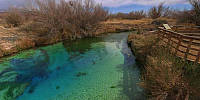
Crystal Spring, shown here, is home to the Ash Meadows species of pupfish. A boardwalk leads from the Ash Meadows National Wildlife Refuge headquarters through alkali flats with scattered mesquite trees. At the end of the trail is perhaps the most beautiful pool of water I have ever seen. The spring water is absolutely pure and also warm (87°F/30°C) - "No Swimming" signs are very necessary.
The Ash Meadows area has three species of pupfish (Devils Hole, Ash Meadows, and Amargosa River). To the west, in Death Valley, there are two more (at Salt Creek and Saratoga Spring), and in Owens Valley yet another (Fish Slough), each in its unique environment. Other desert pupfish populations occur in Arizona, New Mexico, Sonora, west Texas and at Quatro Cienagas in Coahuila, Mexico.
More VR panoramas of this area in Don Bain's Virtual Guidebook to Las Vegas and Southern Nevada.
Location
Lat: 36° 25' 12" N
Long: 117° 20' 50" W
Elevation: 2180 feet/665 meters
Precision is: Medium. Nearby, but not to the last decimal.
Equipment
Photographed with an Olympus E-3 digital SLR with an 8mm Zuiko fisheye lens, on a Nodal Ninja VR mount, Really Right Stuff ballhead, and Velbon carbon-fiber tripod. Five bracketed exposures, stitched with PTGui Pro 8.0.2 on a Macintosh Intel Core 2 Duo iMac, tone mapped with Photomatix Pro, retouched with Photoshop CS3, converted to QTVR using CubicConverter.
 Tap or click the zoom icon in the bottom right corner of the picture to switch between in-page and fullscreen view