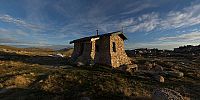

Seaman's Hut - Overlooking the Beginnings of the Snowy River
Kosciuszko National Park, NSW, Australia
March 23, 2008 - (7:39am - 7:46am local time)

Loading panorama viewer ...
Configuring ...
© 2008 Simon Wheaton, All Rights Reserved.
Caption
Seaman's Hut - Overlooking the Beginnings of the Snowy River
Kosciuszko National Park, NSW, Australia
Seaman’s Hut overlooks the beginnings of the Snowy River, a river made famous through early Australian stories, poems, songs, and folklore.
The Snowy River unfortunately now is only a shadow of it’s former self, after being dammed a few kilometers downstream at the Guthega Pondage to feed the Guthega Power Station, and then again further downstream at Lake Jindabyne, where it’s waters are mostly diverted elsewhere via tunnels through the mountain range for hydro electricity generation and to provide irrigation for farmlands on the Western side of the mountain range. These dams and tunnels are part of the Snowy Mountains Scheme, completed in 1974 after 25 years of construction, said to be the greatest water, electric scheme in the world, and is the largest engineering project undertaken in Australia. The scheme consists of 16 dams, 145 kilometres of trans-mountain tunnels, and 80 kilometres of aqua ducts. Originally 99% of the river’s flow was to be diverted inland, but this is now recognized to have caused major environmental problems for the river, and in 2002 6% of the natural flow was restored, with a target of 21% in 10 years. The Snowy Mountains Scheme, although a great engineering feat at the time, creates negative environmental impacts due to the damming and diverting the majority of the river’s flow inland to the West of the mountain range, rather than its natural course east to the sea, which would mean that it would most probably not be approved today.
Seaman’s Hut was built in 1929 by the NSW Tourist Bureau, with finance from the parents of Laurie Seaman. Laurie Seaman perished near the current hut site on August 14, 1928, during a blizzard while waiting for his companion, Evan Hayes, who also died in the blizzard. The hut is a much appreciated emergency shelter, having no doubt saved many lives, and is very close to Australia’s highest mountain, Mount Kosciuszko.
The path in front of the hut is called Summit Walk, which is a walking/bicycle track and management vehicle track that leads from the end of Kosciuszko Road, next to Charlottes Pass ski resort, up to the summit of Mount Kosciuszko. The Summit Walk used to be called Summit Road and was open for public vehicle access until it was closed in 1976 due to environmental concerns. It previously allowed the public to drive up to Rawson’s Pass, just below the summit of Mount Kosciuszko.
LINKS
- Kosciuszko Huts Association: http://www.kosciuskohuts.org.au/
- NSW National Parks and Wildlife Service: http://www.nationalparks.nsw.gov.au/
- Peace River Studios: http://www.peaceriverstudios.com/
- Acratech Inc.: http://www.acratech.net/
- New House Internet Services B.V. (PTGui): http://www.ptgui.com/
- Garden Gnome Software Pano2QTVR: http://gardengnomesoftware.com/
Location
Australia - New Zealand / Australia
Lat: 37° 27' 58" S
Long: 148° 16' 52.5" E
Elevation: 2020 Metres
Precision is: High. Pinpoints the exact spot.
Equipment
HARDWARE
- Canon EOS 350D DIGITAL (EOS Digital Rebel XT) Camera
- Canon BG-E3 Battery Grip
- Canon RS-60E3 Remote Switch
- Canon EF-S 10-22 mm f/3.5-4.5 USM Zoom Lens
- Canon EW-83E Lens Hood
- Peace River Studios 3Sixty Panoramic Camera Mount
- Manfrotto 338 Levelling Base
- Acratech Universal Cork Top Quick Release Camera Plate
- Acratech Ultimate Ballhead Tripod Head
- Gitzo G1227MK2 Mountaineer Carbon Fiber Tripod
- Inca Hotshoe-mount Dual Spirit Level
- SanDisk Extreme III 1GB CompactFlash Memory Card
- NextoDI Nexto-CF ND-2500 60GB Portable Storage Device
- Garmin eTrex Vista C GPS Receiver
- Burton Snowboards F-Stop Camera Backpack
- Cannondale 05 Jekyll Mountain Bike
SOFTWARE
- Adobe Photoshop CS2 (RAW Image Conversion, Image Editing and Adjustments)
- New House Internet Services B.V. PTGui (Panorama Stitching)
- Helmut Dersch's Panotools (Panorama Stitching)
- New House Internet Services B.V. PTGui (Panorama Blending)
- Andrew Mihal's Enblend (Panorama Blending)
- Thomas Rauscher's Pano2QTVR (Blended Panorama Image to QTVR Movie Conversion)
EXPOSURE
- Panorama Type: Spherical
- Number of Images: 37 (3 rows x 12 images, 1 x nadir image)
- Focal Length: 10mm (16mm at 35mm film equivalent)
- Aperture: f/13
- Shutter Speed: 1/125 second
- Sensor Sensitivity: ISO 100
 Tap or click the zoom icon in the bottom right corner of the picture to switch between in-page and fullscreen view