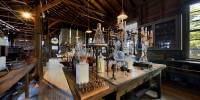

Thomas Edison's Fort Myers Lab
Fort Myers, Florida, USA
December 3, 2005 - 13:30 UTC (08:30 local time)

Loading panorama viewer ...
Configuring ...
© 2005 Dave Cook, All Rights Reserved.
Caption
During World War I, Thomas Edison, Henry Ford and Harvey Firestone became aware that the supply of rubber in the U.S. could be cut off and there would be major problems in their industries. In 1927, they set up the Edison Botanic Research Corporation. The lab was built in 1928 so that Edison could find a source of natural rubber from a plant that could grow in the U.S. The funding for the project came from Edison, Ford and Firestone. The capital to start was $75,000: $25,000 from each of the three men. Edison's continued share was in labor and personnel.Edison tried several thousand plants and found 40 that he could cultivate on a large scale. He focused on goldenrod, a common weed, which grows to 3-4 feet with a 5% yield. He developed a strain that grew to a height of 12 feet and had a yield of 12% latex.
Equipment
Nikon D70s, Nikkor 10.5mm Fisheye Lens, 360Precision Pano Head, Manfrotto Tripod/Leveling Base
 Tap or click the zoom icon in the bottom right corner of the picture to switch between in-page and fullscreen view